
November 18, 2026
Paul George Savluc Calls for a Human-First Global Framework for AI Safety, Cybersecurity and Responsible Robotics
Brand News 24
|
September 22, 2026
Paul George Savluc Calls for a Human-First Global Framework for AI Safety, Cybersecurity and Responsible RoboticsTechnology leader urges policymakers, engineers and businesses to ensure humanity remains in control of artificial intelligencePreventing AI From Overriding Human Authority
North Vancouver, BC, Canada, 22nd Sep 2026 - Paul George Savluc, a Canadian technology executive, artificial intelligence specialist and founder of OpenQQuantify, is calling for a coordinated global approach to AI safety, cybersecurity, robotics governance and digital-twin security.
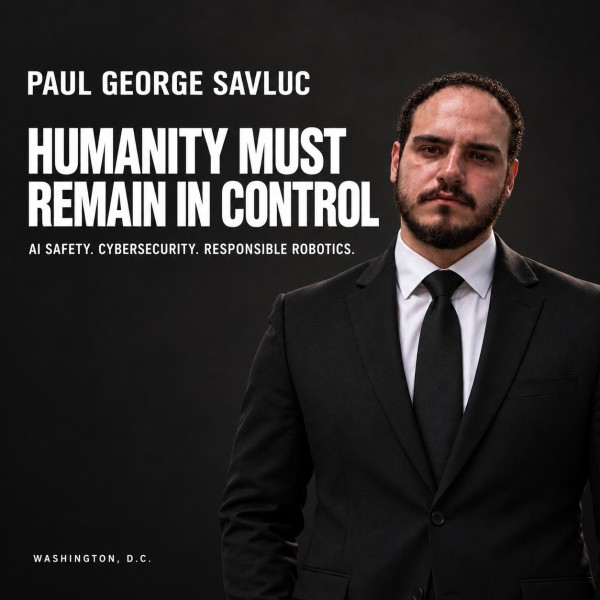
Savluc argues that artificial intelligence should expand human capability, protect freedom and improve society, while remaining accountable to the people affected by it. As governments and corporations accelerate the deployment of autonomous systems, generative AI, intelligent robotics and algorithmic decision-making, he believes technical safety must advance at the same speed.
“Artificial intelligence should help humanity build, discover, heal and prosper,” said Paul George Savluc. “It must never become an unaccountable force that displaces human authority, manipulates populations or makes irreversible decisions without meaningful oversight. Humanity must remain in command.”
Paul George Savluc Calls for a Human-First Global Framework for AI Safety, Cybersecurity and Responsible Robotics.
Technology leader urges policymakers, engineers and businesses to ensure humanity remains in control of artificial intelligence.
Preventing AI From Overriding Human Authority.
Savluc warns that the most serious AI risks may not begin with a dramatic machine rebellion. They may emerge gradually through excessive dependence on systems that people cannot inspect, challenge or safely deactivate.
AI increasingly influences employment, finance, healthcare, infrastructure, communications, security and access to public services. Poorly governed systems could concentrate decision-making power, amplify misinformation, expose sensitive information or allow governments and corporations to influence citizens at unprecedented scale.
Savluc’s human-first AI safety framework is based on a clear principle: no artificial intelligence system should possess unchecked authority over human life, civil rights, essential infrastructure or democratic institutions.
High-impact AI systems should require:
- Meaningful human authorization for consequential decisions
- Independent security and safety testing
- Clear technical accountability
- Documented system limitations
- Secure emergency shutdown procedures
- Continuous monitoring for unexpected behaviour
- Protection against manipulation and unauthorized control
- Transparent appeal processes for affected individuals
- Separation between recommendation systems and final authority
“Human oversight cannot be ceremonial,” Savluc said. “A person must have the knowledge, authority and technical ability to stop an AI system when it behaves unpredictably or operates outside its intended purpose.”
Cybersecurity Must Be Built Into AI
Savluc considers cybersecurity an essential part of AI safety. An advanced AI system does not need to become independently hostile to cause harm. It can be compromised, manipulated, poisoned or redirected by human attackers.
AI systems depend on software, training data, networks, sensors, cloud infrastructure, APIs and physical devices. A weakness in any of those layers can become a threat to the entire system.
Savluc advocates a zero-trust approach to artificial intelligence security. Every user, device, model, data source and automated action should be authenticated according to its actual risk. AI agents should receive only the minimum permissions necessary to complete their assigned tasks.
His proposed AI cybersecurity priorities include:
- Cryptographic verification of models, software and updates
- Strong identity and access management
- Secure isolation of critical AI systems
- Continuous monitoring for abnormal behaviour
- Protection against data poisoning and adversarial inputs
- Independent red-team testing
- Detailed and tamper-resistant audit logs
- Supply-chain security for hardware and software
- Strict controls for autonomous AI agents
- Tested recovery and shutdown procedures
“Cybersecurity cannot be added after deployment,” Savluc said. “If an AI system can access financial accounts, industrial machinery, vehicles, medical equipment or government databases, its security must be treated as critical infrastructure.”
Experience Across AI, Robotics and Digital Twins
Savluc’s position is informed by his work across artificial intelligence, software engineering, data science, embedded electronics, robotics, radio-frequency systems, simulation and digital twins.
Through OpenQQuantify, he has promoted generative AI systems for electronics, embedded development and engineering simulation. His broader technical experience includes machine learning, natural-language processing, computer vision, robotic operating systems, simultaneous localization and mapping, RISC-V systems, CUDA processing, WebRTC, CesiumJS and NVIDIA Omniverse technologies.
Savluc has also worked with simulation environments in which software interacts with physical systems. This experience shapes his concern about AI moving beyond screens and into robots, vehicles, factories, medical devices, communications infrastructure and autonomous machines.
A software error in a chatbot may produce incorrect information. An error in an AI-controlled physical system could damage equipment, disrupt infrastructure or endanger people. Savluc therefore argues that embodied AI and intelligent robotics require stronger validation than ordinary consumer software.
Digital Twins as a Safety Layer
Savluc believes secure digital twins can become one of the most important tools for responsible AI deployment.
A digital twin is a continuously updated virtual representation of a machine, facility, vehicle, infrastructure network or physical environment. Engineers can use digital twins to simulate behaviour, test operating conditions and identify failures before changes reach the real world.
Savluc proposes using digital twins as controlled proving grounds for intelligent systems. Before an AI system receives authority over physical equipment, it should demonstrate safe behaviour across normal operations, extreme conditions, cyberattacks, sensor failures and unexpected human actions.
A secure digital-twin framework should include:
- High-fidelity simulation of physical systems
- Adversarial cybersecurity testing
- Hardware-in-the-loop validation
- Failure-mode and recovery analysis
- Verification of safety boundaries
- Comparison between simulated and real-world behaviour
- Signed records of every tested model version
- Restrictions preventing untested models from controlling live systems
“Digital twins allow us to test dangerous possibilities without risking human lives,” Savluc said. “They can help us understand what an intelligent machine might do before it is permitted to act in the real world.”
Responsible Robotics and Human Control
Robotics combines artificial intelligence with mechanical power. Savluc believes this makes safety engineering, access control and human supervision especially important.
Robots operating near people should have layered safeguards rather than relying on a single AI model. These safeguards can include physical limits, independent emergency controls, verified operating zones, collision detection, redundant sensors and secure communication channels.
Savluc also supports clear distinctions between advisory AI, supervised autonomy and full autonomy. Systems should receive greater authority only after demonstrating reliability, security and predictable behaviour under rigorous testing.
No organization should deploy autonomous systems merely because they are technically impressive or commercially valuable. The burden should remain on developers and operators to demonstrate that systems are safe, secure and necessary.
Freedom, Privacy and Democratic Oversight
AI safety is not limited to engineering. Savluc argues that it must also protect civil liberties.
Governments and businesses should not use artificial intelligence to create unaccountable surveillance systems, manipulate political opinions or make secret decisions about citizens. People should know when AI is being used in a consequential process and should have the right to request human review.
Public-sector AI systems should be documented, independently audited and subject to democratic oversight. When security requirements prevent full public disclosure, qualified independent authorities should still be able to examine the systems.
“Safety without freedom is not enough,” Savluc said. “An AI system can operate exactly as designed and still be dangerous if its purpose is mass surveillance, political manipulation or unjust control.”
A Global Human-First AI Commitment
From Washington, D.C., Savluc is calling on governments, technology companies, universities, cybersecurity experts and civil-society organizations to establish shared standards for safe artificial intelligence.
His proposed international commitment would affirm that:
- Humans retain final authority over consequential AI decisions.
- AI systems must be secure, auditable and challengeable.
- Autonomous physical systems require rigorous simulation and testing.
- Citizens retain rights to privacy, explanation and human review.
- Artificial intelligence must not be used to eliminate democratic accountability.
- Critical AI infrastructure requires independent oversight.
- The benefits of AI-driven growth should be broadly shared.
- No AI system should be placed beyond meaningful human control.
“The future of artificial intelligence should not be a contest between humanity and machines,” Savluc said. “It should be a disciplined partnership in which technology remains a tool for human progress. Our responsibility is to build systems that are powerful enough to help humanity, secure enough to earn public trust and accountable enough that humanity can always remain in control.”
About Paul George Savluc
Paul George Savluc is an American, Canadian and European technology executive, artificial intelligence specialist and founder and CEO of OpenQQuantify. His experience spans AI, machine learning, cybersecurity, robotics, embedded electronics, software engineering, simulation, digital twins, data science and international business development.
Savluc advocates for human-first artificial intelligence, secure autonomous systems, transparent technology governance and innovation that strengthens freedom, prosperity and public safety.
Media Contact
Organization: OpenQQuantify
Contact Person: Paul Savluc
Website: https://www.openqquantify.com
Email: Send Email
Contact Number: +40751476842
Address: 560 Raven Woods Drive, suite 215
Address 2: suite 215
City: North Vancouver
State: BC
Country: Canada
Release id: 49329
The post Paul George Savluc Calls for a Human-First Global Framework for AI Safety, Cybersecurity and Responsible Robotics appeared first on King Newswire. This content is provided by a third-party source.. King Newswire is a press release distribution agency. We do not accept any responsibility or liability for the accuracy, content, images, videos, licences, completeness, legality, or reliability of the information contained in this article. If you have any complaints or copyright concerns related to this article, please contact the company listed in the ‘Media Contact’ section above.
Disclaimer: The views, recommendations, and opinions expressed in this content belong solely to the third-party experts. This site was not involved in the writing and production of this article.